

What is HTML?
How appealing is the text you’re reading? Does it have good or bad structure? What about the images above? Well, all of these things are encompassed within HTML. At its foundation, HTML uses tags to create structure.
A tag is represented between two angle brackets (<>). This text is labeled with a tag behind the scenes that you can’t see: <p>. The ‘p’ stands for the start of a paragraph, which tells the system how to structure the text (font, sizing, etc.). The end of this paragraph is represented with a closing tag: </p>. This tells the system where the structure ends. Images follow a similar concept, but their tag is <img>. HTML is the foundation for all of these structures.

What is CSS?
CSS came next in this trilogy, and it controls the look and feel of headings and text. While HTML is for writing text and giving structure, CSS focuses more on visual appeal.
In fact, that’s why CSS was created. Marketers wanted to take the bland appearance that HTML provides and turn it into something consumers want to engage with. This is not to be confused with interactivity; CSS is purely a visual component, or at least it used to be. As time goes on, CSS continues to encroach on interactivity, potentially phasing out JavaScript.

What is JavaScript?
As you navigate this page, exploring various tabs such as the home page or the “Uncategorized” page, you are using JavaScript. JavaScript is responsible for all interactivity within a webpage. It truly paved the way for pages like Google and Safari, where you can click on thousands of links and have instant access to a website.
As mentioned before, this technology is slowly being incorporated into CSS and may soon be a piece of internet history due to JavaScript’s lack of security. However, for now, JavaScript, CSS, and HTML are all parts of the internet’s basic technologies.
The Beginning of the Internet: LO1
To the right, we see an image of the man many credit as one of the modern internet’s founding fathers, Tim Berners-Lee. Mr. Berners-Lee released the first HTML scripts, HTML 1.0, in 1993 after more than two years in design and almost four years after his creation of the World Wide Web, or, as we know it on our computers, www. Though by today’s standards this 18-tag script would be considered elementary, it laid a wonderful foundation for the 100+ tags we have today.

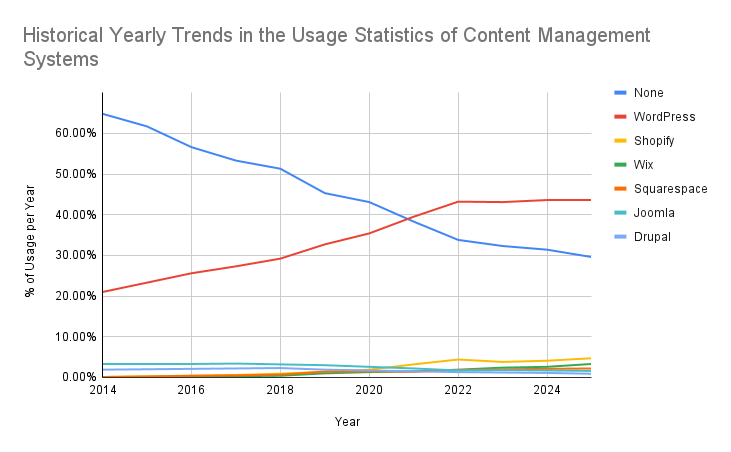
Content Management Systems
To the left is an Excel graph I created of the most used content management systems. These systems take the basic technologies—HTML, CSS, and JavaScript—and turn them into pages just like the one you’re on now. The system you are seeing right now is managed by WordPress, which, as you can see, leads the industry by almost 40%. These systems make it easy for users to develop their own webpages with things like themes (a good starting point for page format) and plugins (which add functionality).
All text on this page was checked for spelling, grammar, & puntuation using Gemini 2.0 on 2/10/25 with the prompt “Could you check the following for grammar, spelling, and punctuation”.